
When Europe pressures Africa to adopt “our” values on issues such as LGBTQ, the results are often counterproductive. Maybe we should stop giving advice unless we are asked to do so, writes Malena Liedholm Ndounou who has been working in West Africa for several decades.
The opinions expressed in the article are those by the author.
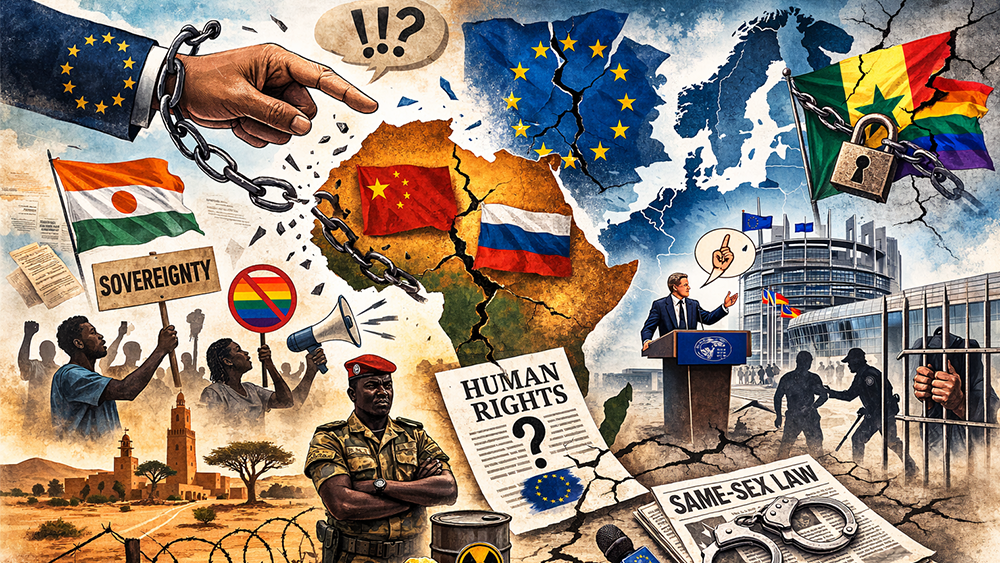
I have written before about the fact that many Africans increasingly prefer partners such as China and Russia to traditional partners such as Europe and “the West”. This is explained by a widespread conviction that Westerners are neo-imperialists who want to control and exploit Africa. Furthermore, Africans often feel that Europeans are trying to shove Western values down their throats. Human rights are getting an increasingly bad rap since they are seen as a Western invention. Rather than accepting Europe’s moral demands, many Africans now prefer partnerships with China and Russia even though their conditions are economically less advantageous.
Two recent events, one in Niger and one in Senegal, have put the spotlight on the rejection of Western values and of European moral injunctions.
On March 11th, the European Parliament unanimously adopted a resolution condemning the arbitrary detention of the Nigerien President Bazoum who was ousted by a military coup in July 2023, calling for his immediate release. The next day, Niger’s Ministry of Foreign Affairs summoned the European Union’s representative in Niamey to accuse the EU of interfering in Niger’s internal affairs and of adopting a paternalistic and condescending attitude.
Also on March 11, the Senegalese parliament passed a law that doubles the maximum prison term for same-sex relations to 10 years, by a vote of 135 in favour, zero opposed and three abstentions. This was preceded by a crackdown on the LGBTQ community, with dozens of arrests over the last month. During the debate in Parliament, many of the MPs denounced the West trying to impose homosexuality on Africa.
I personally deplore President Bazoum still being detained (together with his wife, in two rooms in the basement of the presidential residence). And I am appalled by the hardening of the Senegalese law and deeply worried by recent arrests. However, I see clearly that European intervention in these matters, rather than improving things, are actually making them worse. In the current context of increasing distrust of Europe, resolutions such as the one by the European Parliament are actually counterproductive.
To illustrate my reasoning, I will quote comments on Facebook posts and recent discussions in a WhatsApp group with members from French-speaking West Africa.
Suspicious interest from EU?
Regarding the EU’s call for the liberation of President Bazoum, many argue that the EU’s interest in Bazoum is suspicious and hides other motives, such as the access to uranium.
“The EU wants to plunder Niger. Like locusts in a field, they want to take every last bit of wealth, no matter how small. The reality is that they have used Bazoum to carry out their plans.”
“The EU is confirming the shady dealings that existed between them and former President Bazoum—otherwise, why is this any of their business?”
One comment sums up the general sentiment: “European leaders think that Africans are always stupid.”
Commenters also deplore what they see as the West’s double standards. While the EU demands the liberation of Bazoum (without knowing anything about the reasons the military government still detain him), they don’t demand the liberation of Maduro or condemn the killing of Khamenei.
“As long as these Western powers continue to apply double standards, their credibility and legitimacy will suffer, and it is time for them to understand that the unipolar system has been coming to an end since 2008, and that they can no longer be the sole agenda-setters of the world order.”
The deeper analysis is that this EU initiative is completely counterproductive and constitutes the surest way to keep Bazoum in prison. The op-ed by independent Nigerien journalist Soumana Idrissa Maïga in L’Enquêteur on March 13th with the headline ”Why Bazoum’s prison door slams shut every time Europe opens its mouth” sums it up scathingly and elegantly. Quote below in my translation:
By lumping Niger together with Russia in a single barrage of condemnation, the European Union is vainly attempting to maintain its geopolitical standing. It brandishes morality like one would brandish a water gun against a tank. The question igniting social media this morning is brutal: do these 524 voices still carry the weight of a single grain of sand in the vast Sahelian desert? The answer is scathing and final: European diplomatic strategy is completely obsolete.
Amid this dialogue of the deaf, the fate of former President Mohamed Bazoum has almost taken a back seat. He is being sacrificed on the altar of an ideological standoff that is beyond his control. Europe is buying itself a clear conscience at little cost, drafting resolutions that will end up in the dustbin of history. In Niamey, they have already moved on.
Values as cultural poison
As for the law doubling the prison term for same-sex relations in Senegal, the MPs made it very clear that it was a reaction to the West trying to impose homosexuality on Africa. MP Mr Guy Marius Sagna declared “We believe that LGBTQ values constitute a cultural poison that has been deliberately instilled in our people through television, media outlets, and embassies that fund LGBTQ organizations.” MP Ms Fama Be declared with pathos “Here in our Africa, here in Senegal, we don’t accept this homosexuality! That’s not in our culture! That’s not in our tradition!”
The next day, a French politician posted a video deploring the law and saying that he felt ashamed of Senegal. These are some of the comments he received:
“We are African; we have our own cultures and customs. Deal with it.”
“Africa for Africans—our cultures belong to us. It’s none of your business.”
“Who are you to presume to judge a law passed by the parliament of a sovereign nation? This law is what the Senegalese people want and desire. You’re nobody here.
“We have our own values. No to homosexuality in Africa… Please don’t stick your noses into our business.”
“Let the Senegalese adopt the laws that suit them. Keep your values; we’ll keep ours.”
“Stop contaminating Africa with your unnatural practices.”
What are our lessons learned?
So, if moral pressure is counterproductive, what consequences should we as Europeans draw from this?
We should certainly not renounce our values or even hide them. But maybe we should consider not flaunting them, or at least not shoving them down anyone’s throats. Like any psychologist will tell you, don’t give advice unless you’re asked to do so. We could also start by remembering that the rights that we Europeans hold dear today haven’t always been respected or considered important on our own continent.
Above all, we should start actually listening to Africans and their convictions, rather than speaking down to them from a space of moral superiority. We have to stop claiming that we hold the moral high ground. Stepping down from an attitude of superiority is the only way to create a true dialogue and an equal partnership. And it is the only way for Europe to maintain respect and credibility in Africa.
Malena Liedholm Ndounou
Consultant in gender, leadership and rights with a focus on West Africa
Read also
|
Uppläsning av artikel
|