
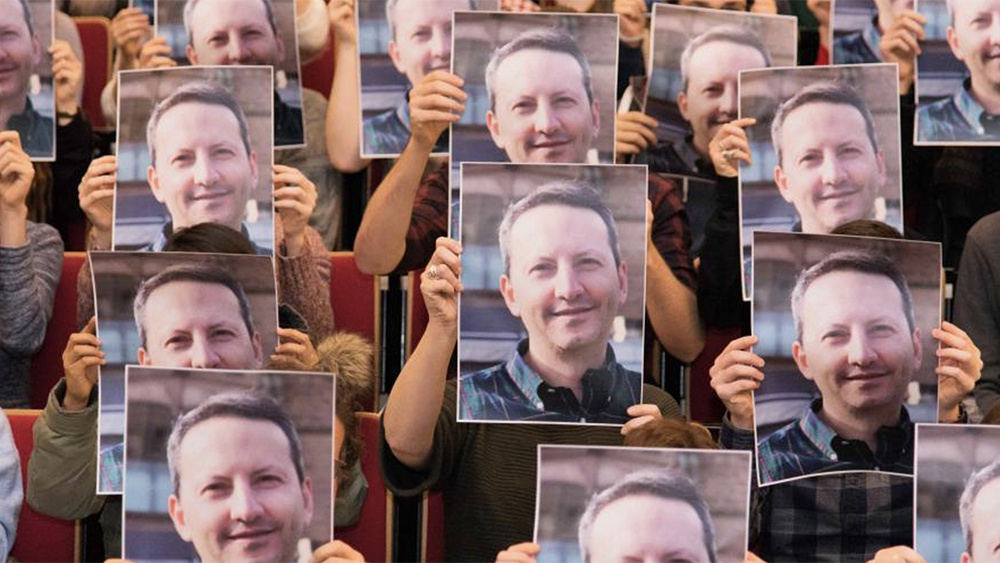
ANALYSIS.The Swedish citizen Ahmadreza Djalali has now spent 10 years in Iranian prison. While Swedish governments have worked hard to secure the release of native-born Swedes such as Johan Floderus, Sweden has maintained a strict wall of silence when it comes to Ahmadreza Djalali, writes Susanne Berger from the Raoul Wallenberg Centre for Human Rights.
This is an analysis. The opinions expressed in this article are those by the author.
The 10-year anniversary of Ahmadreza Djalali’s detention in the Islamic Republic of Iran marks a devastating moment for him and his family. It is also a time for taking stock how Sweden and the rest of the international community have handled his case.
Djalali, an Iranian born physician and medical scholar, has been imprisoned in Tehran’s notorious Evin Prison under a death sentence since 2017. In 2024, he was left behind in a prisoner exchange with the Islamic Republic that freed Swedish EU diplomat Johan Floderus and Swedish Iranian businessman Saeed Azizi.
Along with Dr. Djalali’s critical situation, Sweden is currently dealing with two of the most protracted political prisoner cases in recent memory. Swedish Eritrean journalist Dawit Isaak remains imprisoned in Eritrea, for almost 25 years now; and Swedish Chinese publisher Gui Minhai who was kidnapped from Thailand and taken to China in 2015. He is currently serving a ten-year sentence, following a secret trial held in 2020. Unlike Ahmadreza Djalali, who until a few weeks ago was able to communicate from prison in sporadic phone calls, family members have not been allowed any contact with either Gui or Isaak and they do not know their exact location or state of health.
The 10-year inflection point
The 10-year anniversary cuts especially deep. For exhausted families, the unrelenting emotional stress becomes virtually unbearable. Public interest and focus wane. Power dynamics change. New political crises erupt, creating distractions and forcing new policy approaches.
A look back in history underscores the point.
In March 1956, eleven years after the disappearance of Swedish Holocaust hero Raoul Wallenberg in the Soviet Union, Swedish Prime Minister Tage Erlander was on the verge of abruptly canceling his planned visit to Moscow, the first by a Swedish head of state after the Second World War. The reason was the Soviet authorities’ persistent denial of any knowledge about Wallenberg’s fate in the run-up to the visit, despite strong evidence that he had been imprisoned in the Soviet Union. Erlander’s advisor, the diplomat Lennart Petri (at the time the Deputy Chief of Mission in Moscow), argued in favor of a measured response. “Even if Raoul Wallenberg should still be alive,” Petri wrote, “one cannot let Swedish Soviet relations depend on one individual. “
A new sense of realism
Swedish Minister for Foreign Affairs Maria Malmer Stenergard recently signaled that she has decided to follow a similar course. She emphasized that even though the fate of Ahmadreza Djalali, Gui Minhai and Dawit Isaak remains “very important”, Sweden is not going to let their cases define future relations with either Iran, China or Eritrea.
Such sober realism seems to have been the driving factor behind Malmer Stenergard’s decision to visit China last October – on the 10th anniversary of Gui Minhai’s detention – in connection with a $2 billion-dollar direct investment by Swedish truck manufacturer Scania. The same clear-eyed pragmatism appears to have guided Malmer Stenergard’s visit to Eritrea last December, which focused primarily on securing Swedish and broader European interests in the volatile Horn of Africa. It apparently did not include any prior assurances that Eritrea would release Dawit Isaak or permit consular access to him.
A mixed record of releases offers key lessons
Overall, Sweden’s record of solving cases of arbitrary detention and enforced disappearance across eight decades is at best mixed. The problem is not Sweden’s relatively low rate of success (given that such cases are inherently difficult and complex), but the fact that the authorities do not seem inclined to maximize outcomes or to explore alternative approaches that could make the handling of unlawful detentions of Swedish citizens abroad more effective.
While every situation is different, past cases offer valuable insights that should provide impetus for further study and consideration.
Time is not on your side
Ahmadreza Djalali, Gui Minhai and Dawit Isaak today remain at the same or even greater risk than at any point in their imprisonment. In all three cases, Swedish officials failed to respond quickly and decisively to their respective arrests. Officials were hoping that by staying quiet and working behind the scenes, the situation would somehow resolve itself. If there is any lesson to be drawn it is that time is not your friend. With a few exceptions, as time goes by, the conditions to win the release of political prisoners do not improve but become increasingly difficult.
Sweden has so far failed to impose any serious costs on either Iran, Eritrea or China for the decades long torture and illegal imprisonment of its citizens. Swedish officials rarely pursue a proactive strategy. In the case of Ahmadreza Djalali, the Swedish government focused its efforts on quietly ensuring that Iran would not to impose the death penalty instead of vigorously seeking his release.
Swedish officials apparently hoped that the same formula would also work for Habib Farajollah Chaab, a Swedish citizen and Arab nationalist abducted in Turkey in 2019. He was executed by hanging in May 2023; and for Kourosh Keyvani, another Swedish citizen arrested last year, on charges of spying for Israel. Both trials were deeply flawed yet Swedish diplomats rejected a more direct approach. They did not seek to apply punitive measures like visa and travel bans for Iranian diplomats, eliminating exchange programs for Iranian scholars, the freezing of assets, or the imposition of tougher targeted sanctions via the EU or the U.S. Unlike France, Sweden declined to submit a complaint against Iran before the International Court of Justice (ICJ). Only when Keyvani was tragically executed last month did Swedish officials finally adopt some of these steps.
The Swedish government has followed this restrained approach even in cases where the asymmetric power balance clearly favors Sweden, as in the case of Eritrea, one of the world poorest and weakest nations (despite its close ties to global powers like China and Russia).
Projecting strength and credibility is a must
Silent diplomacy and behind-the-scenes deal making are a central part of negotiations. At the same time, maintaining credibility is an absolute must. Threatening serious consequences for the failure to meet Swedish demands to free its citizens without proper follow through makes Sweden look weak – which authoritarian regimes ruthlessly exploit.
In 2022, Sweden quietly paid SEK 18 million (€ 1.6 million) via UNICEF to maintain deliveries of key medical supplies to Iran, for the treatment of the painful genetic skin condition epidermolysis bullosa (EB) that affects mostly children. It is unclear what concessions, if any, this humanitarian gesture secured. Meanwhile, in 2024, the Swedish Security Police warned that Iran is using criminal networks located in Sweden to plan terror acts throughout Europe. Nevertheless, as recently as a year ago, the Islamic Republic News Agency reported that Sweden was exploring plans for expanded trade ties with Iran, despite heavy international sanctions in place at the time.
In the case of Dawit Isaak, Eritrea has so far simply ignored the Swedish Foreign Minister’s public demand for his imminent release posed more than six months ago, without suffering serious ramifications.
Public advocacy can play an important role
Swedish officials across the political spectrum have failed to utilize one of the most important tools at their disposal, choosing instead to maintain a strict wall of silence. This has arguably allowed authoritarian regimes important additional space to maneuver, with no fear of facing tough challenges in the public arena. The Swedish government claims that public advocacy is rarely effective. While there is certainly a time for silence and quiet negotiations, public engagement can play an important role in enhancing awareness and creating international pressure.
Political will is crucial – as is the lack thereof
Swedish diplomats have repeatedly shown that they are capable of taking decisive action when they see Sweden’s national interest at stake. However, there is evidence of a clear double standard involving dual nationals. It is perhaps no accident that the notable successes in recent years involve almost all native-born Swedes – Johan Floderus in 2023; the journalists Martin Schibbye and Johan Persson in 2012; and Johan Gustafsson in 2017. Since leading government officials are also politicians, it suggests the presence of an unspoken political calculus. If harm had come to a Swedish diplomat like Johan Floderus, the public outcry would have been considerable. Leaving behind a dual national like Ahmadreza Djalali involved far less political consequences.
On the whole, official Swedish actions convey a profound lack of urgency. It is doubtful that Swedish diplomats would have taken such a disengaged approach in the early phases of the detentions of Dawit Isaak and Gui Minhai if they had been native born Swedes.
Despite a formal finding by the UN Working Group on Arbitrary Detention (UNGWAD) in 2017 (and an urgent appeal by the UN Rapporteur on Torture in June 2025 to immediately grant his release), Sweden has not recognized Ahmadreza Djalali as arbitrarily detained. This fact indirectly signals to the Iranian regime that Swedish officials do not consider him entirely innocent, thereby implicitly lending credence to Iran’s unproven accusations against him. Sweden’s position ignores the fact that Djalali has vigorously denied all charges and that he was convicted in deeply flawed legal proceedings. Through its actions, Sweden has seriously undercut its official advocacy on Ahmadreza Djalali’s behalf; a failure that weighs especially heavily since he has been the victim of serious human rights violations, including severe and sustained torture.
Coordination matters
Sweden’s official handling of cases involving enforced disappearance and similar violations often appears slow, meandering and overly bureaucratic. Unless deemed absolutely necessary, Swedish officials are reluctant to coordinate their efforts with outsiders, including family members and their legal counsels, as well as human rights organization and special experts.
With regards to the Islamic Republic of Iran, Sweden held an important bargaining chip in 2019, following the detention and conviction of the Iranian regime official Hamid Nouri for his role in the mass executions of political prisoners in Iran in 1988. Sweden had a chance to act in close coordination with its European and American partners, potentially opening the door to saving a large number of foreign prisoners. Instead, it chose to approach the possibility of a prisoner exchange strictly on a bilateral level.
This limited approach resulted in the successful rescue of two Swedish citizens, but left Ahmadreza Djalali behind, without any viable plan that could lead to his eventual release. Notably, before Johan Floderus’ arrest in 2023, the Swedish government never considered an exchange of Hamid Nouri for Ahmadreza Djalali (and possibly other hostages), stating instead that such an exchange was legally impossible.
Swedish officials did not bother to inform Djalali’s family that he would not be coming home – a needlessly callous act that not only revealed a lack of proper administrative procedures but a seeming unwillingness to deal with family members in a compassionate and humane way. During the most recent hostilities in Iran the Swedish Ministry of Foreign Affairs has not contacted Djalali’s family once to update them about efforts to safeguard him and how to continue to seek his release.
With some notable exceptions, European officials have not fared much better. Aside from the occasional rote statements expressing “concern” or “dismay” over the detention of European citizens, the EU has not mustered to implement any well-coordinated policies to counter international hostage taking or to affect the release of its citizens disappeared, detained and tortured abroad.
International action required
The international community and its system of collective security, via organizations like the EU, the African Union (AU) and the United Nations (UN), have failed almost completely in their shared “Responsibility to Protect”; a lofty goal that exists on paper, with virtually no real life application
Efforts to counter international hostage taking and arbitrary detention are too slow, indecisive, and poorly coordinated. Numerous proposals have been made to remedy this state of affairs, from the appointment of an EU Envoy for Hostage Affairs, to enhanced deterrence through tougher legal mechanisms, like making hostage taking a crime against humanity and designating countries engaging in the practice as state sponsors of wrongful or unlawful detention, as recently introduced in the U.S.
The increasingly close partnership between Sweden and the US – especially via NATO, but also, for example, the 2023 Defence Cooperation Agreement (DCA) or the Technology Safeguards Agreement (which allows the US access to Swedish bases for satellite launches and the transfer of sensitive space technology) – offers Swedish officials crucial influence and access to seek US support in their efforts to rescue Swedish citizens detained abroad.
Other proposals center around the creation of a rapid response force, made up of key experts from government agencies, the military and civil society, that would allow for a fast, multilayered approach to hostage taking. In Europe, few if any of these ideas have been implemented. In Sweden, nobody seems to feel any urgency to seriously consider or even discuss them. [In 2018, the G7 created a Rapid Response Mechanism (RRM), aimed at countering foreign threats (i.e., transnational repression, foreign interference) but it is not specifically targeted towards hostage taking or cases of unlawful detention abroad].
Long family trauma
For family members, the uncertainty and persistent fear for their loved one take over their whole existence. It is the first thought in the morning and the last one at night. The persistent trauma – suffered day in, day out, often for many years – affects their health, their work, their social contacts and most deeply their children.
Adding to the strain is that the aims of officials and family members do not always fully align. Families have only one aim: to rescue their loved ones. Officials must consider many other overarching interests. Resolving these tensions amicably is essential, for the benefit of all.
Families desperately want officials to succeed. Yet they are often shunned, even though they are an underutilized source of vital background information. If secrecy laws do not permit meaningful updates and briefings of family members, then it is time to consider changing these laws to allow for timely declassification of information, while maintaining necessary safeguards. Precedents exist for a relatively quick adjustments to the Swedish legal code if deemed necessary. Swedish lawmakers at home and in the EU have a special responsibility to step up and address this crisis.
Democracy and freedom are not free
Once a citizen has been detained, there will be a price to pay for his or her release. One can pretend that this is not so, but it will not make the government’s negotiation position any easier
Despite warnings about a growing trend of international hostage taking, many officials still consider the numbers to be too low to warrant reforms and to create effective counter measures. Instead of pursuing a principled defense of democratic values, the embrace by many democratic countries of a more “realistic” foreign policy approach is resulting in the dangerous overall downgrading of the status of human rights. This includes a reduced willingness to hold human rights violators accountable, an essential part in the pursuit of justice. It plays directly into the currently prevailing techno-rationalist narrative that might is right and that democracy is feckless and ineffective.
A threat to one is a threat to all
This last point is especially troubling. For far too long, democratic societies have taken democratic rights and freedoms for granted. Many still feel that they have the luxury of compromise as the best way of preserving basic democratic structures. They see it as a risky but necessary gamble.
With increasing authoritarianism around the world, small countries like Sweden feel that they have no choice but to make key concessions. China’s rapid ascent as a global power and its growing dominance of key economic sectors cannot be ignored. At the same time, as Canadian Prime Minister Mark Carney emphasized in his speech in Davos earlier this year, middle countries like Sweden retain important levers of power and influence, if they choose to unite and play their cards right.
It is also useful to remember what democracies are all about. Their most fundamental purpose is to protect individual rights and freedoms. In other words, a threat to one is a threat to all; or as the legendary post-war German prosecutor Fritz Bauer once summed it up, “Democracy is not a steamship whose captain we can entrust ourselves to, but a boat in which we each we all must row together.”
The fight for Ahmadreza Djalali, Dawit Isaak and Gui Minhai must not be allowed to cease or become half-hearted. Their lives and our common future depend on it. As Fritz Bauer wisely said, we are all in this together.
Susanne Berger
Senior Fellow, the Raoul Wallenberg Centre for Human Rights
Read also
|
Uppläsning av artikel
|