
Southern Africa has the resources, markets and human capital to industrialise. What it lacks is the infrastructure, affordable energy, financing and regional coordination to turn those advantages into factories, jobs and prosperity. But this can be changed, argues development strategiest Daniel T. Makokera.
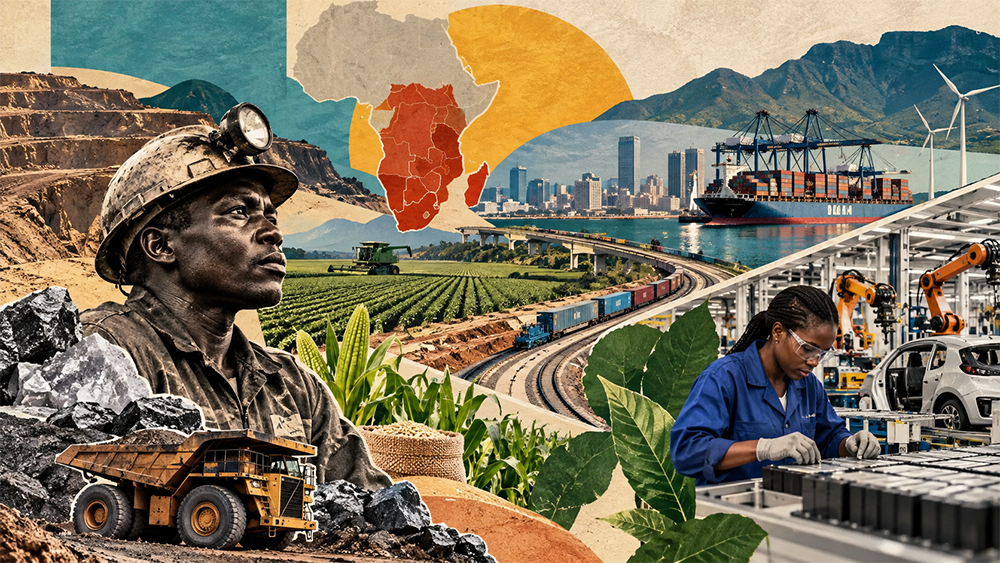
For decades, Southern Africa has exported what the world wants most from Africa: minerals, metals, agricultural commodities, energy and other raw materials. The paradox is that many of the same countries exporting these resources then import the finished products made from them.
Lithium leaves the region as ore or concentrates and returns as processed battery materials. Agricultural commodities leave farms and return as packaged food. Minerals are exported while machinery, chemicals and industrial equipment are imported.
The question confronting Southern Africa is therefore no longer whether it possesses the resources to industrialise. It is whether the region can build the economic architecture required to capture more of the value created from those resources. That is the real meaning of the shift from extraction to value addition. And it may be one of the defining economic debates of the next decade.
The resource paradox
Southern Africa sits on an extraordinary concentration of strategic resources. Zimbabwe is already one of the world’s significant lithium producers. According to the US Geological Survey, Zimbabwe ranked fourth globally in lithium production in 2024, excluding the United States, accounting for about 9 per cent of global production. The mining sector contributed approximately 15.4 per cent of Zimbabwe’s GDP that year, while total goods exports were worth about US$7.8 billion. (USGS)
The Reserve Bank of Zimbabwe illustrates the speed of the lithium boom even more dramatically. Lithium exports rose from US$70.6 million in 2022 to US$674 million in 2023 — an increase of more than eight times. (RBZ)
But the bigger economic question is what happens after the mineral leaves the mine. Mining creates foreign exchange, employment and government revenue. Processing and manufacturing can create much more: chemical industries, engineering services, component manufacturers, logistics businesses, research institutions, skilled employment and new export industries.
That distinction is critical. A tonne of ore is a commodity. A tonne of processed material is an industrial product. A battery component is a manufactured product. And an electric vehicle represents an entirely different level of industrial complexity.
The challenge for Southern Africa is to build the ladder between those stages. Zimbabwe has already recognised the danger of remaining simply an exporter of raw minerals. Its Ministry of Mines and Mining Development explicitly identifies value addition and beneficiation as part of its national mining vision. (Ministry of Mines SA)
But policy declarations alone do not build processing plants. Industrialisation requires electricity, railways, roads, ports, finance, skills, technology, predictable regulation and — perhaps most importantly — a sufficiently large market. That is where regional integration becomes indispensable.
16 small markets
Southern Africa’s individual economies are too small to replicate the scale of China, India or the United States on their own. But the region does not need to. The Southern African Development Community provides a potential industrial market stretching across 16 member states. The objective should therefore be to stop thinking about industrialisation purely within national borders.
A lithium-processing facility in Zimbabwe does not need to serve only Zimbabwe, a copper-processing plant in Zambia should be able to sell into the Democratic Republic of Congo, South Africa, Botswana and beyond, a South African manufacturer should be able to source inputs from Mozambique, Zambia or Zimbabwe, an agricultural processor in Zambia or Malawi should be able to access consumers across the SADC market. This is the logic behind regional value chains.
The African Continental Free Trade Area provides an even larger framework. But trade agreements alone will not create factories. The continent’s intra-African trade remains only about 14.4 per cent of total trade, according to the African Development Bank’s 2025 industrialisation work. Africa also accounts for less than 2 per cent of global manufacturing output. (African Development Bank)
The lesson is clear: tariff reduction must be followed by productive integration. Countries need to specialise, connect their infrastructure and deliberately build industries that feed into one another.
The corridor problem
Industrialisation is impossible if goods cannot move efficiently. Consider two contrasting realities. The Walvis Bay corridor has emerged as an important western route into the SADC hinterland, connecting Namibia to Botswana, Zambia and the Democratic Republic of Congo. Its strategic significance lies not simply in moving containers. A functioning corridor can become an industrial spine around which warehouses, logistics companies, manufacturing facilities, agricultural processing and export businesses develop.
But elsewhere, bottlenecks remain. Beitbridge, the major land crossing between South Africa and Zimbabwe, illustrates the problem. The border has undergone a major modernisation programme and SADC has undertaken assessments aimed at improving customs coordination, one-stop-border-post implementation and transit procedures. (SADC)
Yet delays remain a serious cost to regional commerce. A February 2025 cross-border monitoring report recorded substantial queue and crossing times for heavy vehicles at Beitbridge. In one direction, the median border-crossing time was reported at 26 hours. (Wcoesarpsg) By July 2025, another cargo-movement report showed median border times of 112 hours for heavy goods vehicles travelling from South Africa towards Zimbabwe. (SAPMA) For an industrial economy, this is more than an inconvenience. Time is money.
A factory cannot operate efficiently if components spend days waiting at a border. Perishable agricultural products cannot compete if logistics are unpredictable. Exporters cannot build reliable supply chains when delivery times are uncertain.
Southern Africa therefore needs to stop treating transport corridors merely as roads between ports and borders. They must become industrial corridors. That means deliberately locating factories, logistics hubs, energy projects, warehouses, special economic zones and skills centres along them.
The constraint nobody can ignore
There is perhaps no bigger obstacle to Southern African industrialisation than electricity. Factories need reliable power, smelters need enormous amounts of power, mineral processing needs electricity, cold chains need electricity, data centres, rail systems, irrigation and modern agriculture all require reliable energy.
Yet Southern Africa continues to experience an electricity supply gap. SADC’s 2025 summit publication reported that installed generation capacity across the 12 mainland SAPP countries stood at about 80,450 MW, while the regional power supply deficit was approximately 4,000 MW because of significant suppressed demand. (SADC)
That phrase — suppressed demand — is particularly important. It means the apparent level of electricity consumption does not necessarily represent what the economy actually needs. People and businesses may simply have stopped demanding electricity because the system cannot reliably provide it. That becomes an industrialisation trap. You cannot attract a major manufacturer if you cannot guarantee electricity, you cannot expand manufacturing without investment. And without manufacturing, the electricity demand needed to justify new generation capacity remains suppressed.
Projects such as Mozambique’s Mphanda Nkuwa therefore have significance far beyond the power sector. The proposed hydroelectric project has a planned installed capacity of 1,500 MW. (Portal do Governo). The broader objective should be to combine large-scale generation with regional transmission and new industrial demand. Southern Africa should not merely produce more electricity. It should produce electricity for industrialisation.
Finance is the missing bridge
Even where resources, markets and infrastructure exist, industrialisation ultimately depends on capital. A mine can often attract financing because its commodity can be priced internationally and sold into an established market. A beneficiation plant is more complicated. It requires patient capital, a chemical-processing facility may take years to reach full capacity, a new manufacturing industry may need time to develop local suppliers, a regional industrial corridor requires infrastructure before the factories arrive. This is why conventional short-term commercial finance is often inadequate.
Development finance institutions therefore have a critical role to play. The African Development Bank has long argued that Africa must move up global value chains, expand manufacturing and improve access to capital for industrial enterprises. Its industrialisation programme explicitly links infrastructure, enterprise development, capital markets and industrial clusters. (African Development Bank)
More recently, the Bank has continued to direct capital towards value addition. In October 2025, the AfDB approved US$75 million to support Nyanza Light Metals in South Africa, a project designed to process titanium ore into titanium dioxide pigment at the Richards Bay Industrial Development Zone.
The planned facility has a production capacity of 80,000 tonnes per year and is expected to create up to 850 skilled direct jobs once operational. (Africa Newsroom) This is precisely the type of project Southern Africa needs more of.
The objective is not simply to extract titanium. It is to process it locally, manufacture a higher-value industrial product and create an ecosystem around it. The Development Bank of Southern Africa also has an important regional role. An AfDB-backed ZAR2.2 billion line of credit to DBSA is supporting projects across critical sectors including renewable energy, infrastructure and ICT, with much of the financing directed towards the SADC region. (Map Africa)
The financing model must now go one step further. Africa needs capital that follows the entire value chain — from mine to processing plant, from processing to manufacturing, and from manufacturing to export.
Policymakers frequently discuss industrialisation in terms of strategies and targets. Manufacturers experience it through their electricity bills, transport costs, interest rates, customs delays and the availability — or absence — of skilled workers.
This is why the business voice is essential. A mining company attempting to establish a processing plant can explain precisely how much more expensive it is to process locally than to export concentrate, an agricultural processor can explain how electricity interruptions affect production.
There is also a deeper structural question. Why has Southern Africa struggled for so long to convert mineral wealth into broad-based industrial development? One explanation is that the region has often treated mining, agriculture, infrastructure, energy and manufacturing as separate policy areas. But industrialisation requires them to function as one system.
For SADC, this may be the moment to rethink the meaning of regional integration. The region has spent decades negotiating protocols on trade, transport, energy and investment.
The next phase should be about building productive capacity. Instead of asking simply: How much trade takes place between SADC countries? The more important question should be: What do SADC countries produce together?
That distinction changes everything. A regional industrial strategy could identify sectors in which countries have complementary advantages. The objective would not be for every country to manufacture everything. It would be for countries to manufacture together.
From commodities to capabilities
The African Continental Free Trade Area provides Southern Africa with an opportunity to think beyond its immediate neighbourhood. But the AfCFTA should not become merely a mechanism for moving imported goods around Africa more cheaply. Its greatest potential is as an instrument for building African production.
A factory in Johannesburg should be able to source components from Lusaka, a processor in Harare should be able to sell into Lagos, a manufacturer in Botswana should be able to access consumers in Nairobi. That is what a genuinely integrated African market should look like.
There is an even deeper issue at stake. Industrialisation is not simply about keeping minerals inside Africa. It is about developing capabilities. The ultimate product of industrialisation is therefore not the factory itself. It is the industrial capability created around the factory.
Southern Africa has seen this story before: Commodity prices rise, investment floods into mining, governments celebrate export earnings, jobs are created. Then prices fall. Investment slows, export revenues decline. The economy discovers that much of the value chain remains outside the country.
The region cannot afford to repeat that cycle with lithium, cobalt, copper, graphite and other minerals critical to the energy transition. The green economy could either reproduce Africa’s old extractive model or provide an opportunity to build a new industrial one. The choice will depend on policy.
What Southern Africa should do now
The agenda should be practical.
- Build industrial corridors. Roads, railways and ports should be designed around production zones.
- Guarantee industrial power. New generation should be connected to manufacturing and processing demand, with regional electricity trading expanded.
- Finance the full value chain. Development finance institutions should provide patient capital for processing, manufacturing and industrial infrastructure, not just extraction.
- Make borders invisible to productive trade. A truck carrying components between SADC factories should not spend days waiting for paperwork.
- Develop regional specialisation. Every country does not need to build the same factory. Countries should identify complementary industrial capabilities.
- Use public procurement strategically. Governments are among the largest buyers in the region. Procurement can help create markets for African-made products.
- Build technical skills. Industrialisation without engineers, technicians, welders, electricians, software specialists, managers and scientists will remain impossible.
- Measure value addition. Governments should publish not only mineral export values but also how much processing, manufacturing employment, tax revenue and domestic supplier development those resources generate.
The moment of choice
Southern Africa is approaching a critical moment. The global economy is entering a period in which minerals, energy, food security and industrial supply chains are becoming strategically important.
The region possesses many of the resources the world needs. But possession is not the same as prosperity.
The real opportunity is to move from being a supplier of raw materials to becoming a producer of industrial goods. That requires a different mindset – and one industrial system.
The African Development Bank has repeatedly made the case that Africa must move up global value chains and add value to what it produces. Its current industrialisation agenda continues to prioritise critical-mineral beneficiation, agro-processing, infrastructure, energy and regional industrial development. (African Development Bank)
The challenge now belongs to governments, business, financiers and regional institutions.
Southern Africa does not need another declaration that industrialisation is important. It needs factories. processing plants, reliable electricity. functioning corridors, long-term finance. And it needs governments prepared to coordinate beyond national borders.
The region has spent generations exporting resources. The next generation should inherit an economy capable of processing them, manufacturing with them and building prosperity from them.
That is the real journey from extraction to value addition.
Daniel T. Makokera
Daniel T. Makokera is a Zimbabwe-born South African journalist, broadcaster, media executive and communications strategist. As a former SABC Africa anchor, he founded Johannesburg-based Pamuzinda Productions in 2003. He has worked extensively with African governments and institutions and writes on development, diplomacy and Pan-African affairs.
Read also
|
Uppläsning av artikel
|