

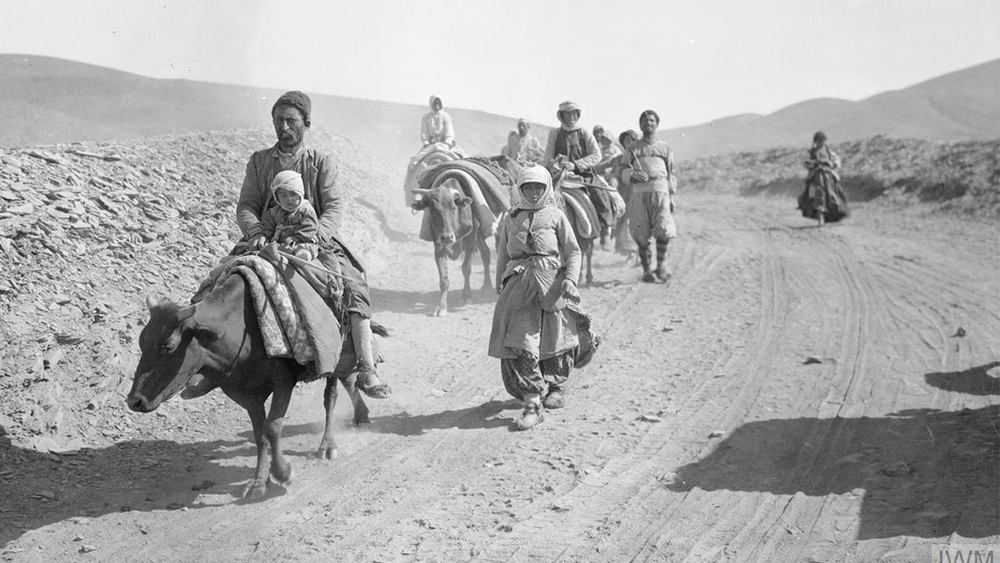
OPINION. The Assyrian Genocide claimed the lives of hundreds of thousands of Assyrian Christians during the First World War. More than a century later, Sayfo remains one of the least recognized genocides of the twentieth century. Why is the rest of the world so silent? Article by Anzhela Mnatsakanyan.
The opinions expressed in this article are those by the author.
Every year on 7 August, Assyrians around the world commemorate one of the darkest chapters in their history. Yet outside their communities, the date passes almost unnoticed. There are memorial ceremonies. Candles are lit. Names are read aloud. Families remember grandparents who never returned home. But beyond those circles, there is mostly silence.
That silence raises an uncomfortable question: Why do we remember some genocides while allowing others to fade from public memory?
The Assyrian Genocide—known in Syriac as Sayfo, meaning “the Sword”—claimed the lives of hundreds of thousands of Assyrian Christians during the First World War. Entire villages disappeared. Ancient churches were emptied. Communities that had lived in their homeland for thousands of years were uprooted almost overnight.
More than a century later, Sayfo remains one of the least recognized genocides of the twentieth century. Ironically, the people whose suffering is so often overlooked belong to one of the world’s oldest surviving civilizations.
The Assyrians are an indigenous people of Mesopotamia whose history stretches back more than three thousand years. They are the descendants of the ancient Assyrian Empire, and despite centuries of conquest and displacement, they have preserved their language, traditions and identity. Today many Assyrians still speak dialects of Neo-Aramaic, the language descended from the Aramaic spoken across the Near East in the time of Jesus Christ. They were also among the earliest peoples to embrace Christianity. According to Christian tradition, the faith reached Assyria through St. Thomas the Apostle and his disciples, Addai and Mari, during the first century. From there, the Church of the East carried Christianity far beyond the Roman Empire, establishing communities across Persia, Central Asia, India and even China centuries before European missionaries arrived. Yet this remarkable history has too often been overshadowed by a history of persecution.

Mass killings and forced departations
For centuries, Assyrian Christians lived as religious minorities, vulnerable to changing empires and political upheavals. During the First World War, those vulnerabilities turned into catastrophe. Beginning in 1915, Ottoman authorities, supported by local armed groups, carried out mass killings, forced deportations and systematic destruction of Assyrian communities across southeastern Anatolia. Ancient settlements were erased, churches destroyed, and entire families forced into death marches or massacred. By the end of the violence, an estimated 250,000 to 300,000 Assyrians—roughly half of the population—had been killed. For survivors, the genocide was not only the loss of lives but the destruction of a homeland that had existed since antiquity.
Unlike other genocides, however, Sayfo never became firmly embedded in global historical consciousness. Part of the reason lies within history itself. Assyrians belonged to different churches—the Assyrian Church of the East, the Syriac Orthodox Church, and the Chaldean Catholic Church—which often developed separate narratives. Their communities were scattered across several modern states, and many survivors lacked the political influence needed to demand international recognition. Meanwhile, denial and silence became powerful tools.
For decades, public discussion of Sayfo was discouraged or ignored. Survivor testimonies remained largely within families, passed from grandparents to grandchildren through stories, prayers, and songs rather than history books. Recognition has slowly expanded. Countries including Armenia, Sweden, the Netherlands, and Germany have formally acknowledged the Assyrian Genocide, while scholars increasingly study Sayfo alongside the Armenian and Greek genocides. Yet internationally, it remains far less known than it deserves. The consequences of forgetting are not confined to history. For many Assyrians, persecution did not end in 1915. The twenty-first century has brought new waves of displacement. The rise of ISIS devastated historic Assyrian communities across Iraq and Syria. Ancient cities such as Nimrud were deliberately destroyed. Churches were bombed. Families who had survived generations of hardship once again fled their ancestral villages. Even today, many Assyrians continue to face discrimination, insecurity, and political marginalization. In parts of their historic homeland, displaying an Assyrian flag or publicly asserting their identity can still provoke harassment or violence. Their cultural heritage also remains under constant threat. Monasteries, churches, archaeological sites, and manuscripts that connect humanity to one of its oldest civilizations continue to disappear through war, neglect, or deliberate destruction. When a people lose both their homes and their history, the loss belongs to all of humanity.
Recognition of genocide is often dismissed as symbolic. It is far more than that. Recognition affirms the dignity of victims. It challenges denial. It strengthens international norms against mass atrocities. Most importantly, it reminds governments and societies that persecution based on identity can never be accepted as inevitable or forgotten with time. Memory alone cannot prevent genocide. But forgetting certainly makes future atrocities easier.
Every year, political leaders repeat the words “Never Again.” Yet those words lose their meaning when they are applied selectively. “Never Again” cannot belong only to the victims whose stories became globally known. It must also include those whose suffering remained on the margins of history.
The Assyrian Genocide deserves recognition not because one tragedy should compete with another, but because every victim deserves the same moral standard. The question is no longer whether the world knows enough about Sayfo. The question is how much longer it will choose to remain silent.
History does not repeat itself because we fail to remember. It repeats itself because we choose whom to remember.
Anzhela Mnatsakanyan
Dr. Anzhela Mnatsakanyan, PhD in Political Science, independent political researcher, and a humanitarian professional. Her research focuses on post-Soviet geopolitics, cultural heritage, and human rights.
Read also
|
Uppläsning av artikel
|